FTL v0.3.0: Bash/Go/Node.js support, containers, Firecracker
2026-11-21
FTL operating system v0.3.0 is released. v0.3.0 improves Linux compatibility layer significantly, and implements fundamental features for cloud environments:
- Bash, Go, Node.js work!
- Linux containers
- Userspace page fault handling
- Firecracker support
Bash, Go, Node.js work!
v0.3.0 implemented Linux features to support more applications such as Bash, Go, and Node.js (to name just a few).
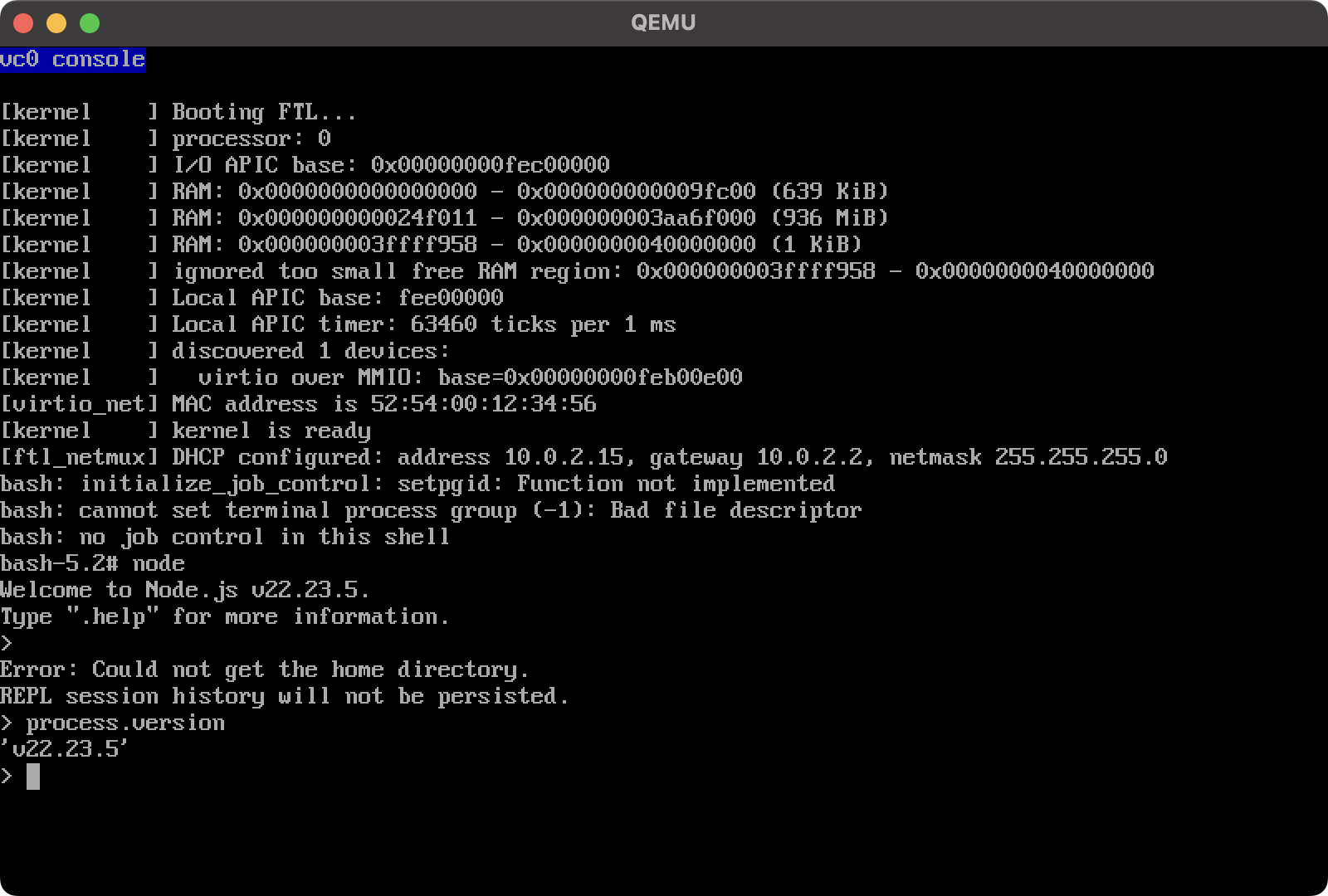
Bash complains that process group is not available, but it already can do some basic shell work!
A fun trivia: To support Go, Linux compatibility layer no longer reuse an application’s stack for system call handling, and has its own stack. This is because Go uses a very tiny stack when calling system calls. if you’re interested in, Unikraft’s deep dive mentions this limitation too.
Linux containers
Linux containers (called zones) are now implemented. Unlike Linux, FTL zones are separate userspace OS instances, and have more flexibility/extensibility and stronger isolation than Linux containers (e.g. separate TCP/IP stack):
# easybox zone /bin/easybox echo "Hello from a Linux container (zone)!"
[zone:stdout] Hello from a Linux container (zone)!
[linux_system] init process exited with status 0
[zone:exit] status 0
An interesting design is … a container is just a file!
// The container specification.
const char spec[] =
    "init /bin/easybox\n"
    "arg echo\n"
    "arg Hello from a Linux container (zone)!\n"
    "exec\n";

// Open a pseudo file to create a Linux container.
int fd = open("/ftl/zone/fork", O_WRONLY);

// Write the spec and spawn it!
write(fd, spec, sizeof(spec) - 1);
Userspace page fault handling
Page faults can be handled by userspace OS now. For example, Linux compatibility layer implements file-backed mmap(2) by:
- Mmap creates a user VM object (VMO), and maps it to the virtual address space.
- When a page fault occurs, the kernel looks up the VMO, writes the fault context to the userspace OS’ stack, and switches to it.
- Userspace OS fills the page, maps the page (
vmo_supplysystem call), and jump back to the faulting instruction.
This is similar to userfaultfd(2) in Linux, and delegate more OS work to the userspace.
Firecracker support
FTL now boots on Firecracker. For all supported cloud environments, see docs/deploy.md.
What’s next
The initial plan in November was to implement an ephemeral file system, but Linux compatibility improvements especially for Node.js went really well and it became really fun :D
I plan to implement the file system next to support container images and start looking into performance improvements to make FTL much faster.